

How To Set Up A Stop Loss On Thinkorswim
Advanced Stock Order Types to Fine-Melody Your Market place Trades
Basic stock club types can still embrace almost of your merchandise execution needs. Peradventure it'south time to move across the basics. Learn about OCOs, bracket orders, stop-limit orders, and trailing stop orders.

Photograph by TD Ameritrade
Central Takeaways
- Avant-garde stock orders are designed for special trading circumstances that crave extra specifications
-
Most advanced orders are either time-based (durational orders) or status-based (conditional orders)
- Advanced gild types tin exist useful tools for fine-tuning your society entries and exits
If y'all're an experienced trader, i whose strategies take grown toward the more than sophisticated side of things, so your merchandise entries and exits might crave a bit of extra nuance. In many cases, bones stock order types can still cover virtually of your trade execution needs. But if your orders require a bit more fine-tuning, there are a host of advanced stock club types at your disposal. As with the more than bones variety of stock orders, you probably want to know these advanced order types really well and then you tin friction match them to the appropriate context and avert errors that could be risky or costly. Note that some order types described here straddle the "basic" to "advanced" category—so you might want to familiarize yourself with all of them to better understand when and when not to use them. Before we get started, there are a couple of things to notation. These avant-garde order types fall into two categories: conditional orders and durational orders. Conditional means that an order is to be filled under specific conditions or that the fill will trigger a status. Durational means that an order must take place within a specific fourth dimension frame, or "time in force". A one-cancels-other (OCO) gild is a conditional order in which two orders are placed, and one lodge is canceled when the other order is filled. This may audio complicated, simply it'south fairly easy to understand in context. Available in nearly trading platforms designed for active traders, a subclass order volition immediately place an OCO "take profit" and a stop guild in one case a position is opened. A stop-limit order allows you to ascertain a price range for execution, specifying the price at which an guild is to be triggered and the limit toll at which the order should be executed. It essentially says: "I want to buy (sell) at price 10 just not whatever higher (lower) than cost Y." Suppose you're eyeing a stock that's trading at $120. You want to buy when the cost reaches $125, simply not if it exceeds $130. And so you lot place a stop-limit order—a buy stop at $125 and a buy limit at $130. By doing this, your guild can get triggered at the lower (specified) price while preventing any orders from being triggered beyond your price limit. And so if the stock opens at a gap beyond $130, your gild isn't filled until the price falls back to $130 or beneath. For short sale positions, yous'd exercise the reverse. If you lot're using the thinkorswim® platform, you tin set up brackets with stop and stop-limit orders when placing your initial merchandise. Nether the Trade tab, select a stock, and cull Buy custom (or Sell custom) from the menu (see figure i).Ane-Cancels-Other Order
Subclass Order
Stop Limit Order

FIGURE one: Bracket ORDERS. To bracket an order with turn a profit and loss targets, pull up a Custom lodge. Epitome source: the thinkorswim® platform. For illustrative purposes only.
This durational guild can be used to specify the time in force for other conditional order types. It basically means: "Keep this club active until I abolish it." Orders that oasis't been filled by the end of the twenty-four hour period are usually canceled once the market closes. But if yous want to proceed a purchase order or sell order in place until it'due south filled, or yet long your broker will allow y'all to keep information technology active (typically no more 90 days), this is when you might want to employ a GTC order. A bit of common sense: If y'all're placing a conditional society blazon that involves two or more orders, make sure that the time in strength (TIF) for each order is identical. For example, if yous're placing an OCO (one-cancels-other) society, it wouldn't be good if the order to be canceled immediately is a GTC (expert 'til canceled) social club. Also, don't confuse a day order (which gets canceled at the end of the day) with a GTC lodge (which doesn't get canceled at the end of the day). Yous don't want to be surprised by a "mystery position" the following 24-hour interval floating effectually in the negative render zone. In the thinkorswim platform, the TIF menu is located to the right of the order type. Trailing stops are non "orders" per se, just they're a means to automatically motility or "trail" stops (basic stop orders). Retrieve of the trailing stop as a kind of exit plan. Here'due south how it works. Allow's say you purchased shares of stock, and your unabridged position is at present in the turn a profit zone. What might you do with your terminate? You tin can leave it in identify. You lot can move it up to a more "break-even" level to avert loss should the market move against you lot. Or you tin ready it to "trail" your profitable position every bit it moves higher. You're probably thinking, "OK, simply how far below my position should the trailing stop follow?" There are many ways to calculate a abaft finish. If you're using the thinkorswim platform, you could pull up an order ticket and select from the menu under the society blazon (see figure 2). The choices include basic order types as well as trailing stops and terminate-limit orders.Good 'Til Canceled (GTC) vs. Day Club
A Quick Notation on Fourth dimension in Strength
Trailing End Society
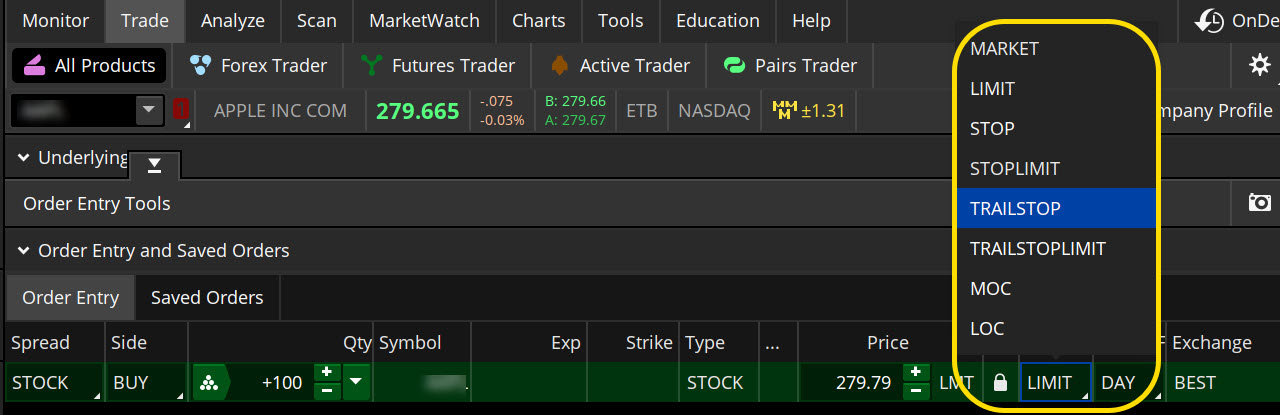
FIGURE ii: Gild TYPES. To select an social club type, choose from the menu located to the right of the price. Prototype source: the thinkorswim® platform. For illustrative purposes only.
Before implementing any of these order types, it'south important to know a few more things about stop orders. With a cease limit order, y'all risk missing the marketplace altogether. In a fast-moving marketplace, it might be impossible to trigger the order at the end price, and then to execute it at the terminate-limit toll or ameliorate, and so you might not have the protection you sought. A abaft stop will not guarantee an execution at or near the activation toll. In one case activated, they compete with other incoming marketplace orders. And, of form, a limit guild doesn't guarantee execution every bit the market may never achieve your limit price. Advanced order types can be useful tools for fine-tuning your social club entries and exits. But you need to know what each is designed to achieve. And as with whatever merchandise thought or component you're trying out for the first time, consider practicing first in a fake environs such as the paperMoney® stock market simulator on the thinkorswim platform.The Lesser Line
Archaic Corner:
A Few Club Types Rarely Used past Retail Investors
Firsthand-or-Cancel (IOC) Order
This durational lodge is similar to the all-or-none order, but instead of dealing in quantities, it deals with time. Substantially, the IOC guild says: "Give me every bit much of my order as possible within this specific time frame (normally a few seconds) and abolish all unfilled orders in one case that fourth dimension has passed." You lot can specify the fourth dimension in force for this blazon of order.
Suppose you want to purchase 5,000 shares of stock, but you don't want to get filled at a broad range of prices. Or peradventure book is on the thin side and you don't want to move the market place. You can identify an IOC market or limit order for five seconds before the order window is closed. You lot might receive a partial fill, say, ane,000 shares instead of 5,000. But y'all can always repeat the gild when prices again achieve a favorable level.
Why this is rarely used: Unlike institutional investors who tin trade at loftier levels of volume, near investors don't have to worry about moving the markets. Arguably, a retail investor can movement a highly illiquid market, such as those for penny stocks. But more often than not, the average investor avoids trading such risky assets (and brokers discourage it). Hence, there'due south not much demand (or need) for this type of order.
All-or-None (AON) Order
Its name says it all: "Give me the unabridged quantity of shares I'm asking for or don't give me any at all." An AON order ensures that yous won't become a partial fill. Then if you order 1,500 shares of a stock, you'll receive exactly that amount, every bit long as there are enough shares at the time of the lodge to fill up your asking.
Why this order type is practically nonexistent: AON orders were commonly used among those who traded penny stocks. Over again, almost investors avoid penny stocks because of their high risk contour, and most brokers prefer information technology that way, if simply to reduce client and broker risk. Hence, AON orders are mostly absent-minded from the club bill of fare.
Fill-or-Kill (FOK) Order
The FOK order is unique in that it'southward the only gild type you don't desire to yell over the telephone to your broker when in a public setting, as people invariably get the wrong idea. Aside from this, the FOK club is like an all-or-cypher (AON) lodge merely with the time limit of an firsthand-or-abolish (IOC) order.
Confusing? It's not, actually. The FOK order essentially means: "Fill my entire club within the specified time frame or kill the order." For instance, suppose you want to buy exactly 500 shares of stock within the next x seconds. If the shares are available within that 10-2nd fourth dimension frame, y'all'll go filled. If not, your order volition elapse after 10 seconds.
Why this order blazon is practically nonexistent: FOK orders, although nuanced with a aptitude toward accuracy, have enough conditionals to make them impractical. In other words, many traders end up without a fill, so they switch to other lodge types to execute their trades. Over time, traders have by and large used other order types, effectively "killing" the fill-or-kill guild through low need.
Want to learn more near bones stock order types? Sentinel this curt video:

Basic Stock Order Types: Tools to Enter & Exit the Market
five:39

Past Michael Turvey
Senior Manager - Institutional Trading Human relationship, TD Ameritrade Institutional
Key Takeaways
- Advanced stock orders are designed for special trading circumstances that require extra specifications
-
Most advanced orders are either time-based (durational orders) or condition-based (conditional orders)
- Advanced guild types tin can be useful tools for fine-tuning your order entries and exits
Get-go your email subscription
Recommended for you
Related Videos
Source: https://tickertape.tdameritrade.com/trading/trading-basics-advanced-stock-order-types-17852
0 Response to "How To Set Up A Stop Loss On Thinkorswim"
Post a Comment